Locally-Shaped Climate Solutions
Putting communities at the heart of climate action
What it means
Youth, women, Indigenous peoples, people with disabilities, and other often marginalised social groups are most affected by the climate crisis. Their lands, houses, livelihoods and culture are at stake. As the climate emergency grows more severe, locally led solutions have emerged as a key element of successful climate adaptation strategies.
Those most impacted by environmental shifts usually possess the deepest insight into their vulnerabilities, which makes them best positioned to craft and carry out effective, on-the-ground solutions.
In contrast to top-down approaches that often miss key local details, grassroots initiatives are shaped by the specific environmental, social, cultural and economic realities of each community.
Locally Led Solutions are:
- More tailored to the local context, reflecting and responding to real socio-economic dimensions and needs;
- Better at harnessing local communities’ innovation capacity and (traditional) knowledge. Local solutions integrate deep-rooted knowledge about the environment, ecosystems, and weather patterns;
- Effective in ensuring local and long-lasting ownership, which is a necessary condition for a truly positive climate impact.
Supporting and facilitating these communities in taking forward these actions helps build a more equitable and resilient future for all.
Our impact
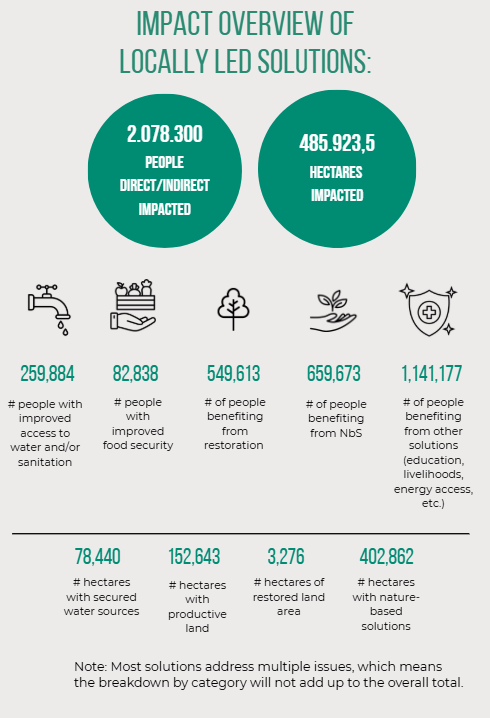
Over the past five years, VCA partners have supported more than 130 locally led solutions. Together we have:
- Positively impacted 2.078.300 people directly and indirectly with locally led solutions
- Positively impacted 485.923,5 hectares of land
Of which:
- 259,884 # people with improved access to water and/or sanitation
- 82,838 # people with improved food security
- 549,613 # of people benefiting from restoration
- 659,673 # of people benefiting from NbS
- 1,141,177 # of people benefiting from other solutions (education, livelihoods, energy access, etc.)
- 78,440 # hectares with secured water sources
- 152,643 # hectares with productive land
- 3,276 # hectares of restored land area
- 402,862 # hectares with nature-based solutions
Note: Most solutions address multiple issues, which means the breakdown by category will not add up to the overall total.
The Scope of Our 130+ Supported Initiatives
Together, we have supported over 130 locally led solutions. This overview presents the various types of solutions implemented across the programme. For example, 25 solutions are focused on food security. In some cases, solutions address more than one issue, such as 18 initiatives that tackled both food security and nature-based solutions. These overlaps are reflected in the total.